Ground — Quorum Seismic Array
Ground is not a collection of independent geophones. The product array is a phased, three-axis volume with 1,024 exact addresses split 341 + 340 + 343. Its selected operating modes belong to the complete worded assembly. The continuum supplies measured pairwise wave responses; the Helix readout supplies the whole-array compatibility law. Removing an axis does not leave a smaller copy of the same instrument.
The product evidence therefore has two separately audited layers. A 48-position public-data fixture tests whether the close-contact read can recover a resource-scale signal from measured mine noise. A second exact architecture receipt tests the 1,024-address quorum census. The fixture is not presented as the product array, and no scale extrapolation joins the two.
Ground resolves acoustic contacts: the top and bottom of a thin, high-contrast body or structure. Seismic contrast can prioritize a resource target; it does not identify elemental composition by itself. Mineral identity remains a corroborating geologic, electromagnetic, geochemical, or drilling result.
- Two contacts out of one one-contact reference peak. The registered contacts are 390.00 m and 409.23 m: 19.23 m apart, or 0.60× the 32.05 m limit of the common eight-channel bandwidth. The one-contact matched-field reference returns one peak at 395.5–396.0 m on all three public-noise looks.
- Three distinct public-noise recoveries. The held-out fixed-address reads return 390.50/410.00 m, 390.75/411.00 m, and 390.00/408.75 m. Alternating receiver positions are excluded from the fit and used to judge the result.
- Noise does not become a resource. With the injected contacts removed, all three measured-noise fields refuse the two-contact model.
- The registered benchmark point is tested, not extrapolated. Measured public mine noise is combined with the declared two-contact injection. At 3 dB the read recovers 1/3 looks; at 6 dB, 2/3; at 9 dB, 3/3. Nine decibels is the lowest tested SNR at which every look and every one-class deletion stress passes.
- The frontier is on the face. All three looks recover through 0.40× the channel limit. At 0.30× only one survives; by 0.10× all three correctly refuse the two-contact claim.
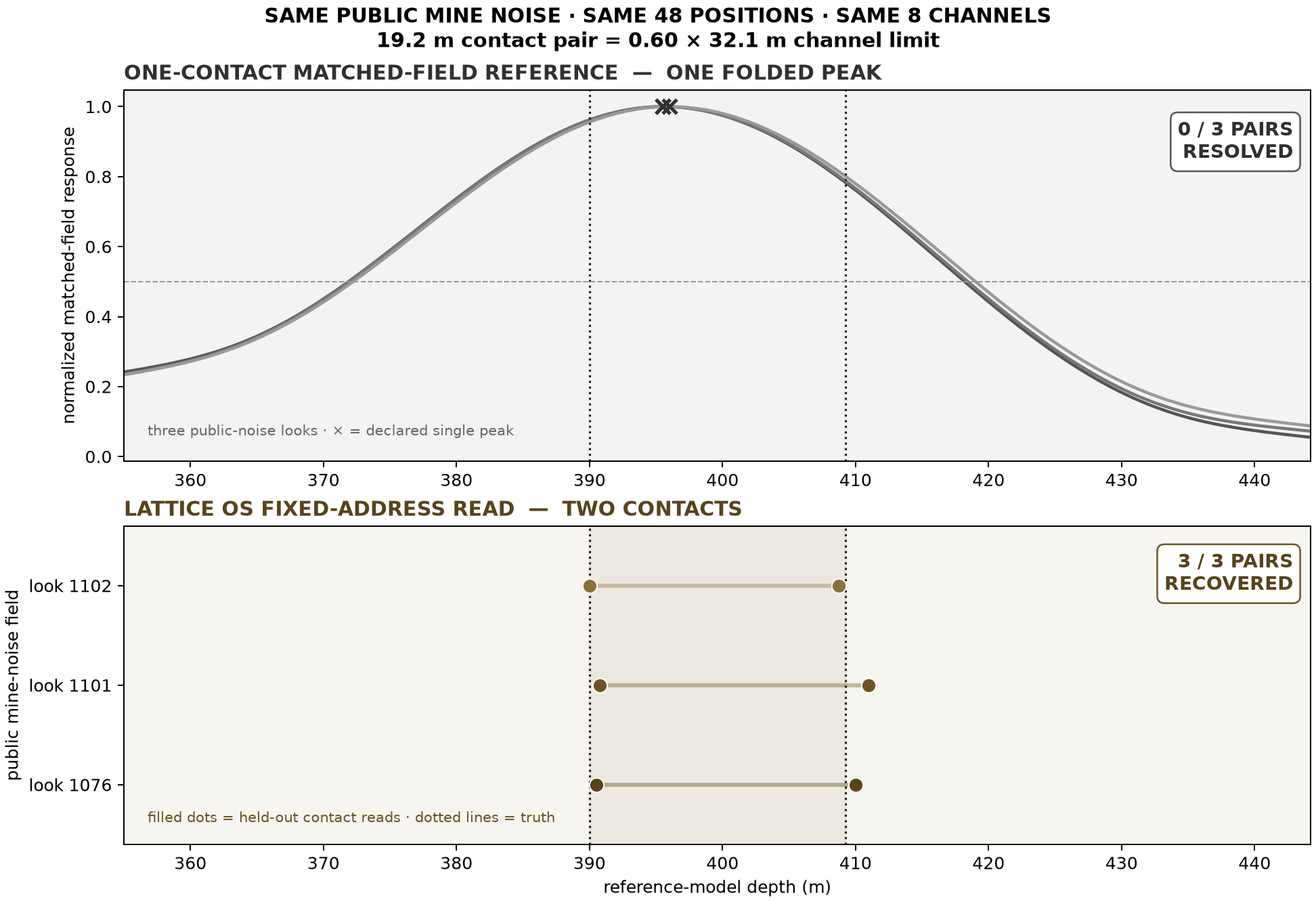
The measured resource-interface result
| Test | What was held fixed | Measured result |
|---|---|---|
| Common input | 48 measured line positions; 8 fixed tones from 11 to 89 Hz; three SIT4ME field-noise looks | same for both readers |
| Hidden pair | 390.00 / 409.23 m; opposite-polarity contacts; declared 5,000 m/s reference conversion | 19.23 m = 0.60× limit |
| One-contact image | complex matched-field profile; half-height and prominence census declared before the read | 0/3 pairs; one peak each |
| Fixed-address read | K=1/K=2 pinned contacts; alternating positions fit / held out | 3/3 pairs |
| Single deletions | 8 spatial residue classes and 8 tone channels removed one at a time | 16/16 pass all looks |
| Null field | same measured noise, injected contacts removed | 3/3 refuse K=2 |
| Frontier | same 9 dB noise fields; only contact separation changed | 3/3 at 0.40×; 0/3 at 0.20× |
The 5,000 m/s value converts two-way time to a declared hard-rock reference depth; it is not inferred from the public field records. The exact measured object is the response in the registered moveout model. This is a semi-synthetic signal-injection benchmark in measured mine noise, not a claim that the raw public survey has been reinterpreted to localize its known ore body.
The array is the mode, not the elements
| Quorum object | Exact result | Meaning |
|---|---|---|
| Physical addresses | 1,024 = 341 + 340 + 343 | three phased axis words |
| Latent volume | 706,814,760,960 sites | compiled; not enumerated as receiver verdicts |
| Dense representation avoided | 3.596×1024 operator entries | entry count, not a projected runtime |
| Operating band | 13 families / 40,338,372 modes | 100% word-born in the complete assembly |
| Protected content | 39,331,004 modes | exact inclusion–exclusion across all axis subsets |
| Failure language | deletion −290; class flip −1,028 | absence and mistuning are different mode-census signatures |
Proper-axis assemblies retain other kernel content; they do not retain the selected word-born operating band. “Below quorum” therefore means the product observable is structurally absent, not that every subset matrix has zero nullity. Passive free-space coupling remains pairwise. The quorum lives in the phased arithmetic readout.
Audit both layers:
resource-interface fixture JSON —
public byte ranges and hashes, receiver and tone Address Books, all readings, SNR census, deletion tests, frontier, refusals, and scope. Deterministic payload audit:
de9e0e421e1d1f194fbac5dd583359cc7f64ef9554f9c51e9310cd79466e208c; downloadable-file SHA-256:
8c8403c5ba861c0be4d5d2328369a9f4122f70c07a9a9f9aaef48d0199ef084c.
quorum architecture JSON —
axis construction, subset counts, inclusion–exclusion, operating-mode closure, fault channels, and boundary. Deterministic payload audit:
87a1cd2837a3560883ef64121e5282f248b0b4319b6e0fa2d56b5185cb92982f; downloadable-file SHA-256:
e0a8f5dfe0c12718444f40817ccd8be4e6b242d1a2f0dc6f2f88916ed3ec35d3.
How Ground is used
- Construct the Address Book for the survey geometry. Public receiver identifiers are not treated as positions. The fixture maps the unit residues to measured arc length; the product compiles three phased axis words into one volume. geometry first · exact addresses · no rectangular fiction
- Read the full complex field. Ground preserves phase and polarity across the fixed channel book. A thin body is a coupled two-contact hypothesis, not two unrelated scalar detections. full field · opposite-polarity contacts
- Fit locally; judge on data that did not fit. Alternating positions estimate K=1 or K=2. The excluded positions must independently reduce the residual before the second contact is accepted. transport holdout · no success-only read
- Return a target interval or refuse. The output is a qualified acoustic contact interval with its receipt and boundary. It is not a mineral assay, and a coherent noise field is not promoted into a two-contact target. interval + status + evidence
Published mathematics and public referees
The novel claim is not that seismic reflection, matched-field imaging, the bandwidth limit, coprime sampling, or VMS exploration exists. Ground composes a fixed integer Address Book, a whole-assembly mode census, a pinned close-contact read, held-out transport, and explicit refusal. The public fixture is auditable from its JSON; a qualified reviewer can request the bounded reference implementation without receiving the private compiler.
- Helix, quorum conservation, sparse sensing, and claim boundaries. A. P. Matos, The Helix Operator: The Exact Integer Helix on the Coprime Substrate, especially §§11.6 and 13.3.3, DOI 10.5281/zenodo.21611872.
- Public mine-noise and geometry source. J. Alcalde, D. Martí, R. Carbonell et al., SIT4ME: Innovative seismic imaging techniques for mining exploration — Sotiel-Elvira (Spain), DOI 10.20350/digitalCSIC/8633, CC BY 4.0.
- Public seismic repository context. D. Martí et al., “Reassessing the lithosphere: SeisDARE, an open-access seismic data repository,” Earth System Science Data 13 (2021) 1053–1071, DOI 10.5194/essd-13-1053-2021.
- VMS seismic imaging precedent and physical contrast. G. A. Donoso et al., “3D reflection seismic imaging of volcanogenic massive sulphides at Neves-Corvo, Portugal,” Geophysical Prospecting 71 (2023), DOI 10.1111/1365-2478.13269.
- Coprime-array prior art. P. P. Vaidyanathan and P. Pal, “Sparse sensing with co-prime samplers and arrays,” IEEE Transactions on Signal Processing 59 (2011) 573–586, DOI 10.1109/TSP.2010.2089682.
- Classical resolution referee. Lord Rayleigh, “Investigations in optics, with special reference to the spectroscope,” Philosophical Magazine 8 (1879) 261–274, DOI 10.1080/14786447908639684.