The whole loaded field — preserve the physical command a scalar read erases.
CARRY · path-dependent full fieldsame scalar q = 3 · different action8-channel exact loaded reference
A scalar power budget declares the two registered routes below identical: they have the same
local faces, the same total loss quantum q = 3, and the same matched load. They are not the
same command. Their cross-fibre glue differs, so they move different tiles and deliver different
force, roll, and pitch.
Selenoform Superhighway returns the complete declared path-dependent field and carries all sixteen
signed coordinates — eight spatial channels times two quadratures — through the calibrated
actuator law, a vendor-reference 1 kHz loss model, carrier coupling, and loading. No scalar summary
or terminal address can reconstruct that field after it has been discarded.
Buy Superhighway when system success depends on where and in which phase force is delivered,
not merely how much total energy was spent. An optimized precomputed response operator can tie
the final 8 × 8 loaded solve; the differentiator is preserving and evaluating the upstream
path-conditioned command that determines which field is applied.
The worked article is a quasi-static matched-load discrete-carrier reference design. It is
exact within that declared model; it is not a bond/contact, hysteresis, frequency-response,
environmental, lifetime, or flight-qualification result.
THE TARGET Two Helix routes on the same 2 × 4
loaded surface, with the same local faces and the same scalar loss q = 3.
THE RESULT The scalar read ties. The full-field read
resolves two different physical commands:
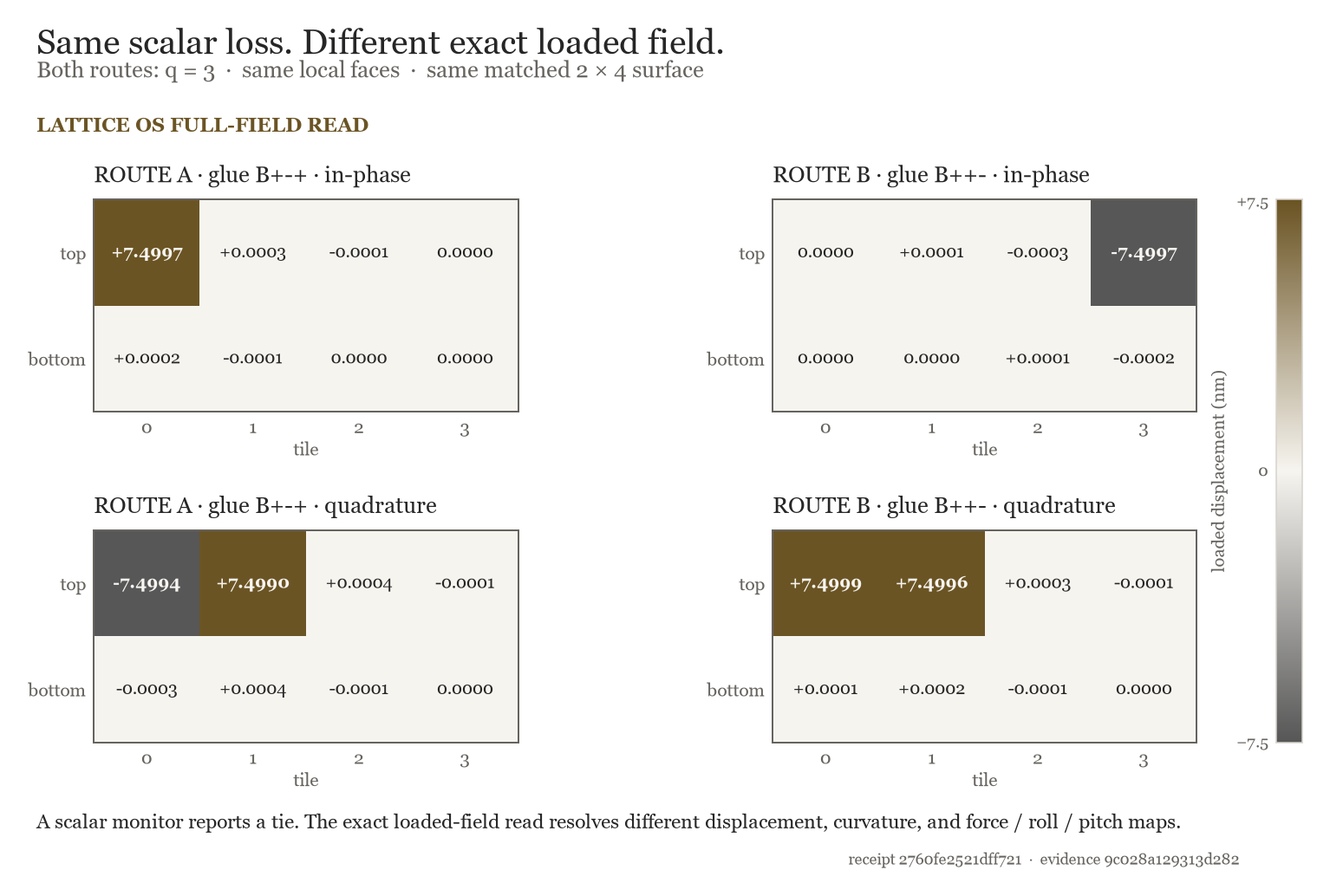
Same loss; different action. Route A and Route B both return q = 3, where q is the
dimensionless sum of squared in-phase and quadrature drive coordinates, yet their loaded
displacement maps, carrier-curvature words, and transmitted wrenches all differ. The distinction
survives the load instead of disappearing at the actuator interface.
The whole surface is addressed. The reference article is a 44 mm × 22 mm array of eight
independently driven Pz26 tiles on a 1.5 mm 6061-T6 carrier. The local traction map has exact
rank 16/16; the loaded carrier transfer has exact rank 8/8 per quadrature. Each unit
command retains its unique maximum on the commanded tile.
The mechanics close exactly. All 324 sealed fields are carried through 648 independent
exact direct solves. Every one of the 5,184 scalar equilibrium residuals is zero; the largest
off-diagonal-to-diagonal generator ratio is 0.0165% at this design point.
The path is not replaced by its endpoint. Local CRT faces do not determine how the roots
join across fibres. The B/+/- glue word carries that missing address, and the loaded witness makes
the address observable as a different physical field.
Compilation makes the full-field inverse tractable. The L = 18 history room has
1618 words but closes on ten congruence skeletons. On the separately measured target,
independent skeleton reconstruction was 3.065 × 10⁶ times faster than the exact
generic frontier. That compute result enables the product; it is not the product claim.
The upper row of each map is tiles 0–3; the lower row is tiles 4–7. Values are
loaded displacement in nanometres, rendered from exact rational results. Both routes have q = 3
and identical local faces; their B/+/- glue differs. A scalar monitor reports a tie. Lattice OS
preserves the address needed to recover the different loaded fields.
Same scalar budget — different physical action
Loaded quantity
Route A · B+-+
Route B · B++-
Total loss quantum
3
3
In-phase normal force
+88.707 N
−88.707 N
Quadrature normal force
0 N
+177.414 N
In-phase roll moment
+0.488 N·m
−0.488 N·m
Quadrature pitch moment
−0.976 N·m
+1.952 N·m
Decimals are presentation only; the displacement, curvature, energy, and wrench
records are exact rationals. The sanitized
field-witness receipt carries both routes, both
quadratures, the declared scope, and audit 9c028a129313d282. No private source or runtime provenance
is included.
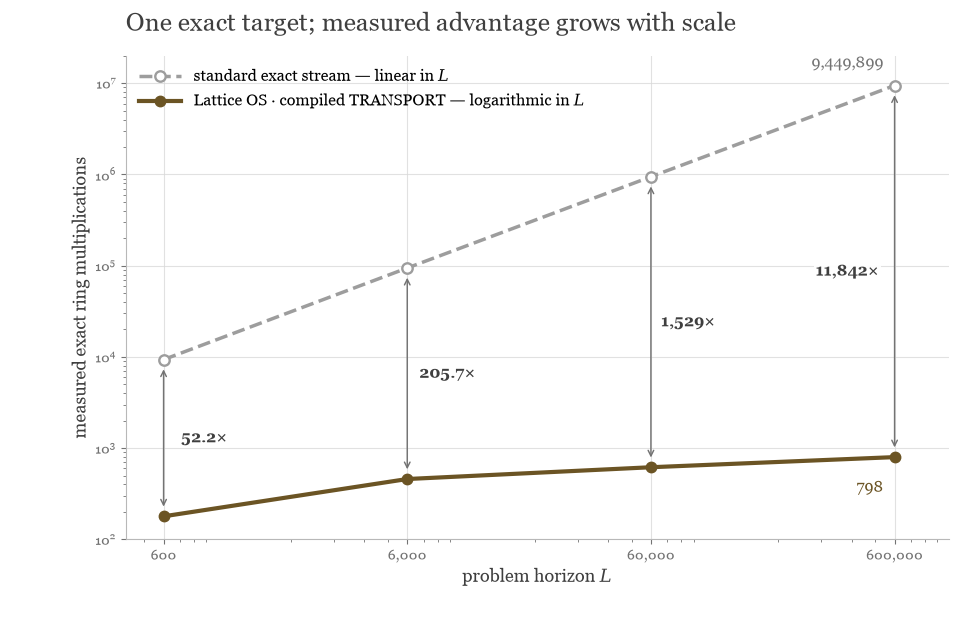
The field witness above is the product claim; this second chart is the evaluator that
makes it practical. Same exact target at every point, with deterministic operation counts rather
than projected time: the standard exact stream is linear in L while Lattice OS compiled TRANSPORT
is logarithmic in L, widening the measured gap from 52.2× to 11,842×. On the
separate L = 18 target, the generic exact frontier took 70.870742 s and the independent
ten-skeleton evaluator took 23.1224 µs, a measured 3.065×10⁶ ratio. The
rounded receipt is available here.
How — preserve the address through the load
Keep the field, not its scalar shadow. The command is sixteen signed
integer coordinates: real and quadrature components at eight physical addresses. Total loss is a
ledger, not a substitute for that field.
8 spatial channels × 2 quadratures · no scalar collapse
Carry the cross-fibre glue. CRT faces describe each fibre; the B/+/-
word records how those faces join. The equal-face witness changes only that joining data and still
produces a different loaded result.
same local faces · different global address
Map every coordinate to a physical channel. Each coordinate drives one
Pz26 tile/quadrature. The exact local traction map has rank 16/16, so no declared degree of freedom
disappears at the device interface.
integer field → 8 tile phasors
Carry the command through the coupled load. Eight reusable exact
response generators produce displacement, curvature, energy, and force/roll/pitch. Independent
exact direct solves referee every field.
full cover · zero equilibrium residual
Compile the history only after preserving its charge. The finite
sufficient-state book and its congruence skeletons reduce evaluation work without identifying paths
that the physical readout distinguishes.
the acceleration serves the field